

What this worksheet helps children practise
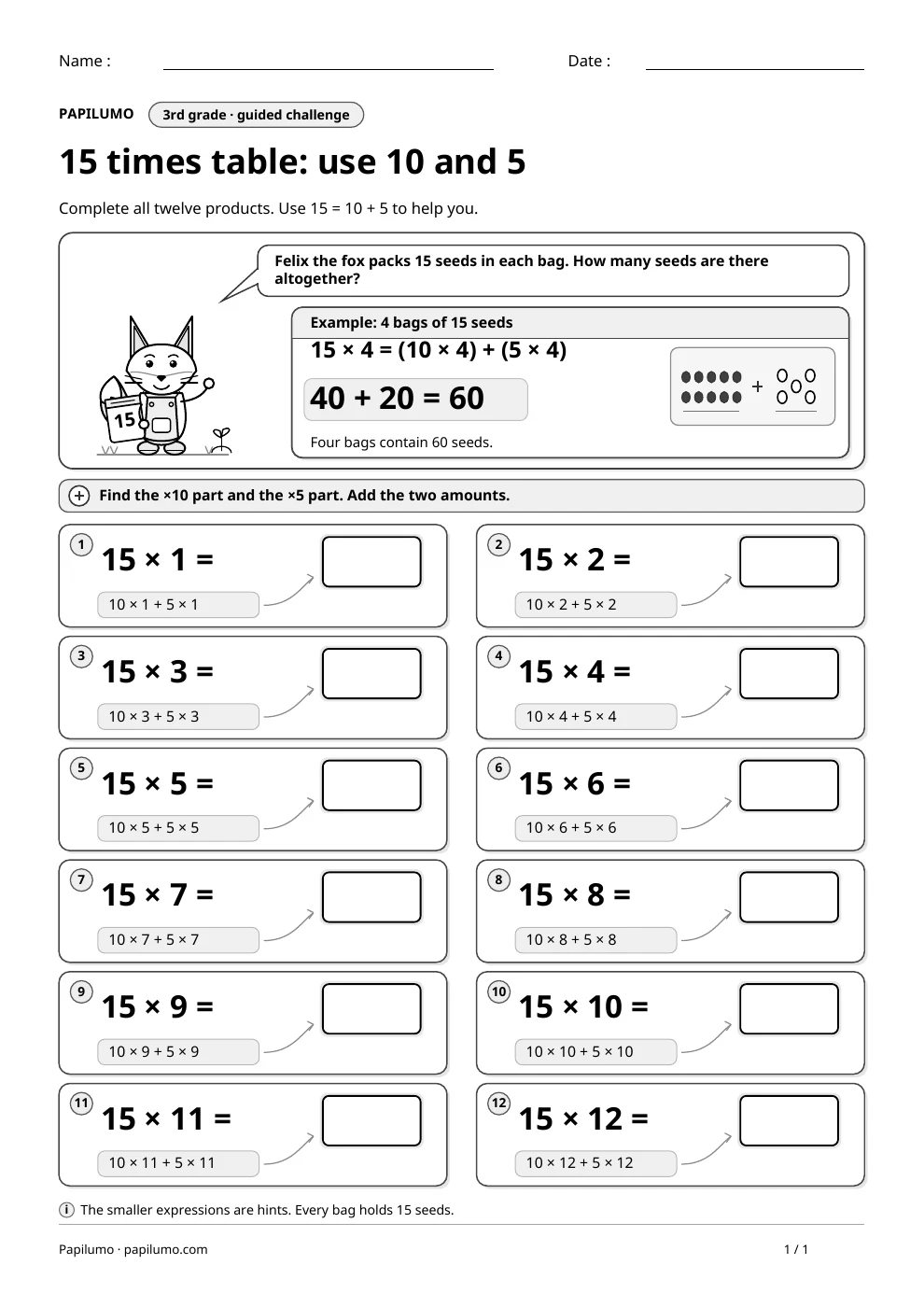
A child may confuse 15 × 7 with 15 + 7. Return to the packets: seven groups of fifteen are different from one packet plus seven loose seeds. Another common mistake is leaving out the second part of the calculation. Ask where the five extra seeds in each packet have gone. Encourage a clear explanation such as “seven groups of ten and seven groups of five.” The fox illustration introduces the situation; it is not a set of seeds that must be counted.
The purpose is to understand multiplication by breaking a factor into easier parts. Fifteen seeds can be split into ten seeds and five seeds. With several equal packets, there are just as many groups of ten as groups of five. This is a guided third grade challenge for children who already understand equal groups and have practiced multiplying by 5 and 10. Memorizing the 15 times table is not a prerequisite. The products on the page range from 15 to 180. For a related skill, use 18 Times Table Practice: Navigator Crown, Guided Cards & Missing Factors with Oli: Complete the × 18 crown target (× 1 to × 6), solve all eight guided cards using (20 × n) − (2 × n), then find the missing factors.
Preparing a short session
Have a pencil, eraser and scrap paper ready for intermediate calculations. Read the garden story and ask what 15 represents: the number of seeds in each packet. The other factor tells how many packets Felix is filling. If needed, draw two packets, each with a group of ten dots and a group of five. There is no need to draw 180 individual seeds. Keep the worked example visible and put the answer key aside while the child works out the totals.
A concrete example to get started
The model is 15 × 4. Four groups of ten make 40, and four groups of five make 20. Combine these parts: 40 + 20 = 60. Four packets therefore contain sixty seeds altogether. Point out that the factor 4 appears in both smaller multiplication problems. Multiplying 10 by 4 and then adding only 5 would count the extra five seeds just once. Each of the four packets contains that extra group of five, so all four groups must be included.
Supporting the activity
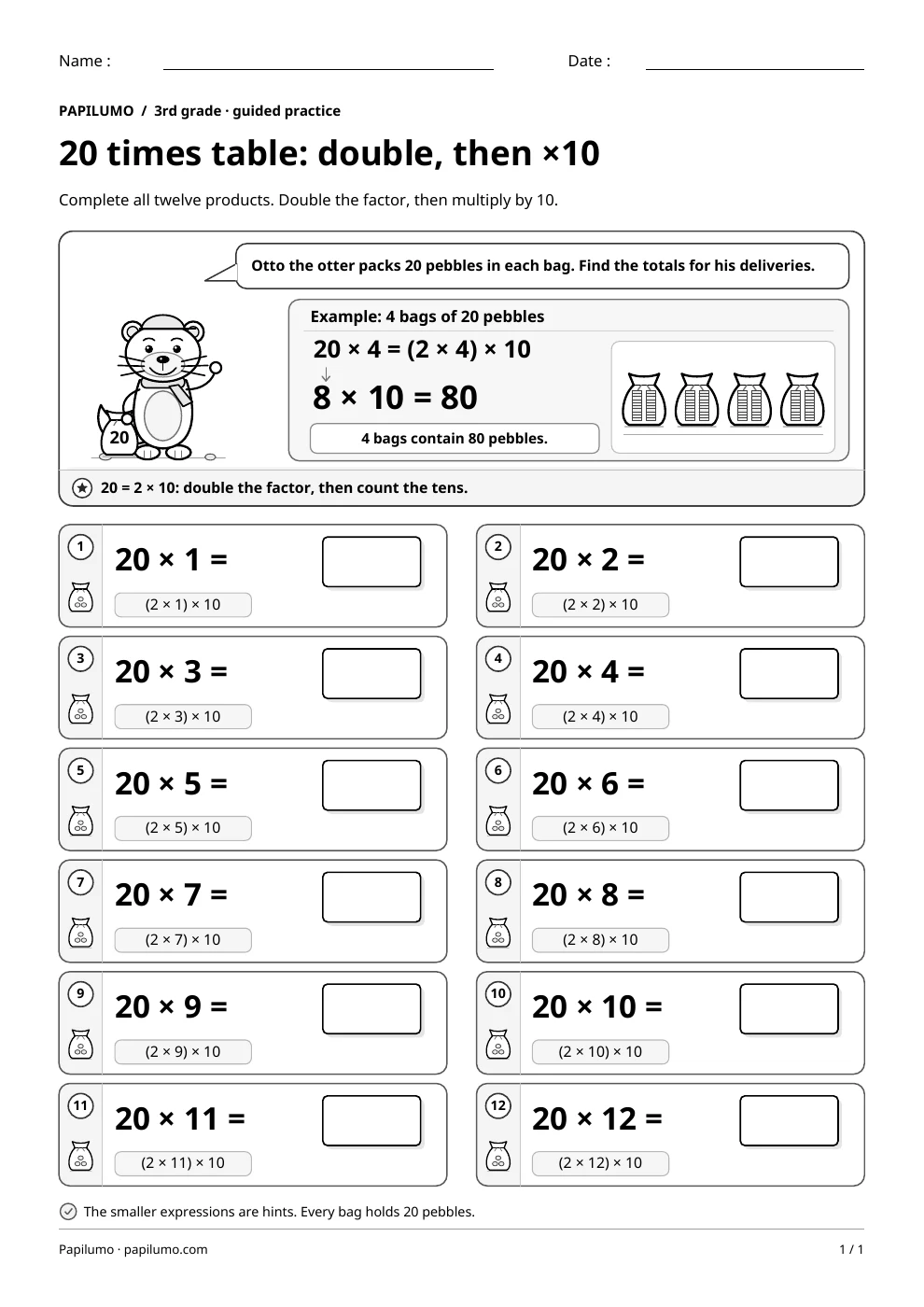
Work from left to right, completing one row at a time. Each problem has a smaller expression underneath showing the matching multiplication by 10 and by 5. The child can say both partial products aloud, write them on scrap paper and put only the total in the large answer box. Start with three or four problems and return later if concentration drops. Do not turn this into a speed test while the child is still explaining how the two groups fit together. To vary the practice, try 20 times table: double, then multiply by 10: Complete all twelve products. Double the factor, then multiply by 10.
What to notice and how to check
In order from ×1 through ×12, the answers are 15, 30, 45, 60, 75, 90, 105, 120, 135, 150, 165 and 180. Neighboring answers should increase by fifteen. Use this pattern to check the work after several products have been calculated through decomposition. For ×7, check 70 and 35 separately before adding to get 105. When an answer differs, identify whether the mistake occurred in multiplying by 10, multiplying by 5 or adding the two partial products.
Making the task easier
Begin with factors 1, 2, 4 and 10. If multiples of five are still uncertain, write a short sequence such as 5, 10, 15, 20 on scrap paper and extend it together. An adult may record dictated numbers while the child explains the quantities. Cover the remaining problems to reduce visual distraction. Return to counting by fives or tens before using the worksheet if finding either partial product takes so much effort that the child loses track of the overall strategy.
Keep the learning aim, but reduce how much the child has to handle at once. Cover part of the page with another sheet and reveal one task at a time. Demonstrate a separate example, then leave a real opportunity to work something out. An answer reached with support is still a useful attempt; it does not yet show that the same task can be completed independently.
Taking the idea beyond the worksheet
Compare two approaches to 15 × 11: 110 + 55, or 150 + 15 starting with ten packets. For twelve packets, 120 + 60 gives the same total as 150 + 30. These checks extend the discussion without changing the printed exercise set. On scrap paper, ask why the ones digits alternate between 5 and 0. Let the child explain using the extra packet of fifteen each time, rather than expecting a memorized rule with no connection to the quantities.
Use the follow-up to meet the same idea in a different setting. Offer it once the first task makes sense, without insisting that the whole page must be perfect. The child might explain a strategy, make an example or set a challenge for an adult. Return to the worksheet only when it helps connect the two situations. A short conversation or a practical activity can be enough to finish the session. To continue exploring, use Add Three 2-Digit Numbers (No Regrouping) with Uma: Line up the ones (O) and tens (T). Add all three digits in the ones column first, then add the tens column with no regrouping.
Downloading and printing the PDF
This free PDF contains one worksheet designed for A4 paper. Download the file using the button on this page and open it in your PDF reader. Choose actual size or a 100% scale, check the orientation in the print preview and turn off any browser headers or footers. The illustrations use vector lines, so their outlines stay sharp when printed. Check the margins on one copy before preparing several sheets for a group. The level shown on the page is a guide, rather than a requirement to complete the activity at a particular age.