


What this worksheet helps children practise
Reread the full sentence with your replacement word from the bank: if the story flips to the exact opposite meaning, you found the right match!
Working with antonyms inside full 2nd Grade sentences strengthens vocabulary depth, sentence-level reading comprehension, and flexible semantic thinking. When learners observe how changing 'full' to 'empty' or 'quiet' to 'noisy' transforms a whole picture in their minds, they connect exact word choice directly to meaning. Pairing a structured word-bank replacement section with a crisp synonym-versus-antonym check also clears up one of the most common early-grammar mix-ups between words that mean nearly the same thing and words that mean the exact opposite. For a related skill, use Cause and Effect Sentences: Match and Complete with Because (Zelie): Part 1: draw a line from each numbered cause on the left to its matching effect on the right. Part 2: finish each 'because' sentence.
Preparing a short session
Print the student worksheet at actual size (100%) on plain white A4 paper and lay out a sharpened wooden pencil and soft eraser on a bright, uncluttered desk. Keep the separate one-page answer key PDF neatly out of sight while your child works independently through both parts. Before writing, invite your second grader to read all six words in the top bank aloud together and lightly check off each word tile as it is used so every sentence finds its matching opposite cleanly without leaving leftovers.
A concrete example to get started
Across the top rounded banner, Milo the Word Fox flips a crisp word tile beside a cheerful speech bubble and a dashed worked-example panel. Inside the example box, students see the clear model sentence ('The box is heavy') with 'heavy' prominently underlined in bold, followed by an arrow pointing directly to its opposite 'light' printed on a mini writing line. With just one quick glance, second-grade readers immediately grasp both how to locate the underlined word and what kind of opposite replacement belongs on the line.
Supporting the activity
Right below the banner sits the six-tile antonym bank displaying 'early, noisy, empty, bright, dry, short' in tidy rounded boxes. In Part 1, six numbered everyday sentences each feature one bold underlined word ('late, quiet, full, dark, wet, long') paired with a generous primary handwriting line with a dashed midline. In Part 2, four clean badge cards present quick pairs ('happy / glad', 'brave / scared', 'tiny / huge', 'fast / quick') where students circle S for Same or O for Opposite. To vary the practice, try Reading Detective: Two Mini-Mysteries and Clue Checklists with Riko: Read all 5 clue sentences in each case, cross out the two choices ruled out by the clues, then write the answer and proving clue.
What to notice and how to check
When both sections are completely finished, set the separate one-page answer key PDF right beside your child’s worksheet to review every single replacement together in a calm moment. The answer key displays all six target antonyms printed neatly on the Part 1 writing lines alongside bold circled S or O badges across all four Part 2 word pairs. Invite your child to read each original sentence aloud and then read the swapped version immediately after it to hear the meaning flip clearly, check spelling carefully, and celebrate confident second-grade reading.
Making the task easier
Act out each pair together first (silent reading corner vs. noisy corner, full basket vs. empty basket) before writing on the lines.
Keep the learning aim, but reduce how much the child has to handle at once. Cover part of the page with another sheet and reveal one task at a time. Demonstrate a separate example, then leave a real opportunity to work something out. An answer reached with support is still a useful attempt; it does not yet show that the same task can be completed independently.
Taking the idea beyond the worksheet
Write two original sentences of your own on the back using the opposite pair 'tiny' and 'huge', or invent a new S/O pair to test a friend.
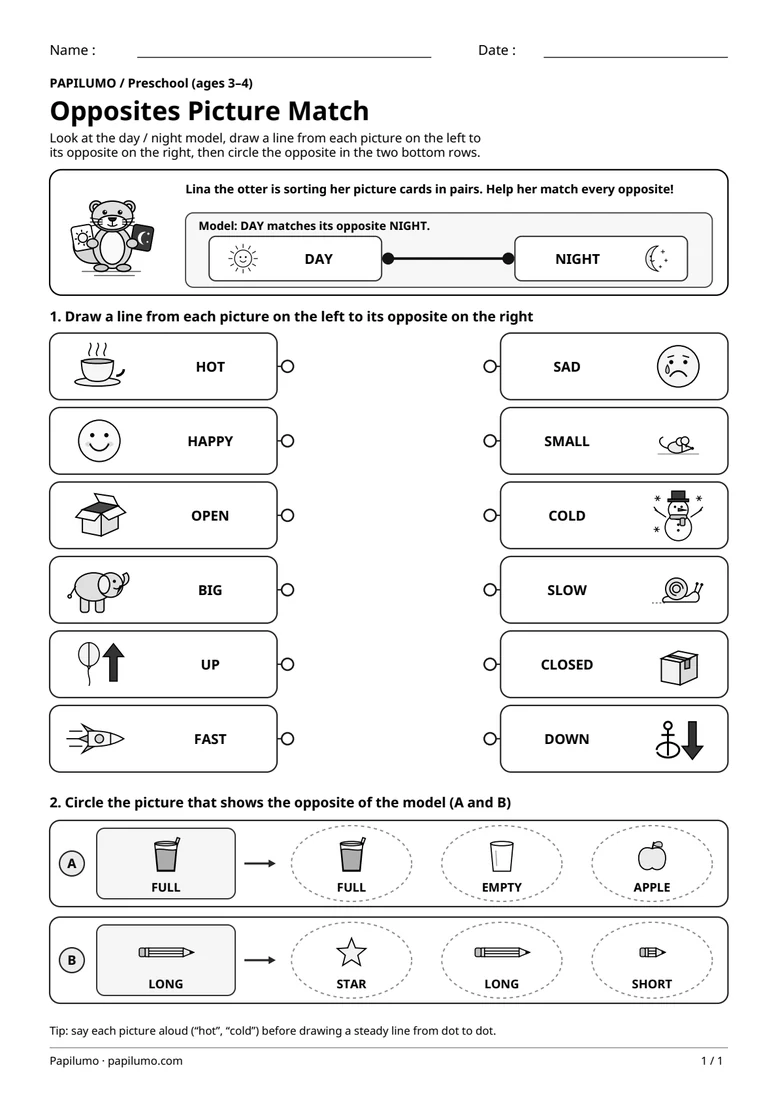
Use the follow-up to meet the same idea in a different setting. Offer it once the first task makes sense, without insisting that the whole page must be perfect. The child might explain a strategy, make an example or set a challenge for an adult. Return to the worksheet only when it helps connect the two situations. A short conversation or a practical activity can be enough to finish the session. To continue exploring, use Opposites Picture Matching with Lina the Otter: Look at the day / night model, draw a line from each picture on the left to its opposite on the right, then circle the opposite in the two bottom rows.
Downloading and printing the PDF
This free PDF contains one worksheet designed for A4 paper. Download the file using the button on this page and open it in your PDF reader. Choose actual size or a 100% scale, check the orientation in the print preview and turn off any browser headers or footers. The illustrations use vector lines, so their outlines stay sharp when printed. Check the margins on one copy before preparing several sheets for a group. The level shown on the page is a guide, rather than a requirement to complete the activity at a particular age.