

What this worksheet helps children practise
Find the smallest pebble first, cross it out, write it on the next stone, and repeat until you reach the largest!
Ordering scattered subsets of numbers between 1 and 10 in kindergarten deepens number magnitude sense and flexible comparison before first grade. Children learn to scan four distinct values, identify the smallest remaining pebble, and evaluate numbers with varying gaps such as 1, 6, 7, and 10 rather than simply reciting 1–2–3–4 from memory. Writing each digit neatly inside a wide stepping stone strengthens pencil fluency, left-to-right sequencing, and early familiarity with the less-than symbol in a calm, approachable visual layout without overwhelming distractions, noisy clutter, or cramped answer boxes. For a related skill, use Counting Backward by 1s Across Tens to 50 with Cosmo the Penguin: Subtract 1 at each arrow (-1) to fill in the missing flags on all 5 snowy tracks, then step back 3 numbers in each vertical gauge.
Preparing a short session
Print the student worksheet at actual size (100%) on plain white A4 paper and set up a quiet, bright workspace with a sharpened graphite pencil and soft white eraser. Keep the separate one-page answer key PDF neatly out of sight while your child works through every crossing. Before starting Row A, invite your child to touch each stone and count aloud along the 1–10 reference number path right below the top banner, noticing together that numbers steadily grow larger as Bibi hops toward the right.
A concrete example to get started
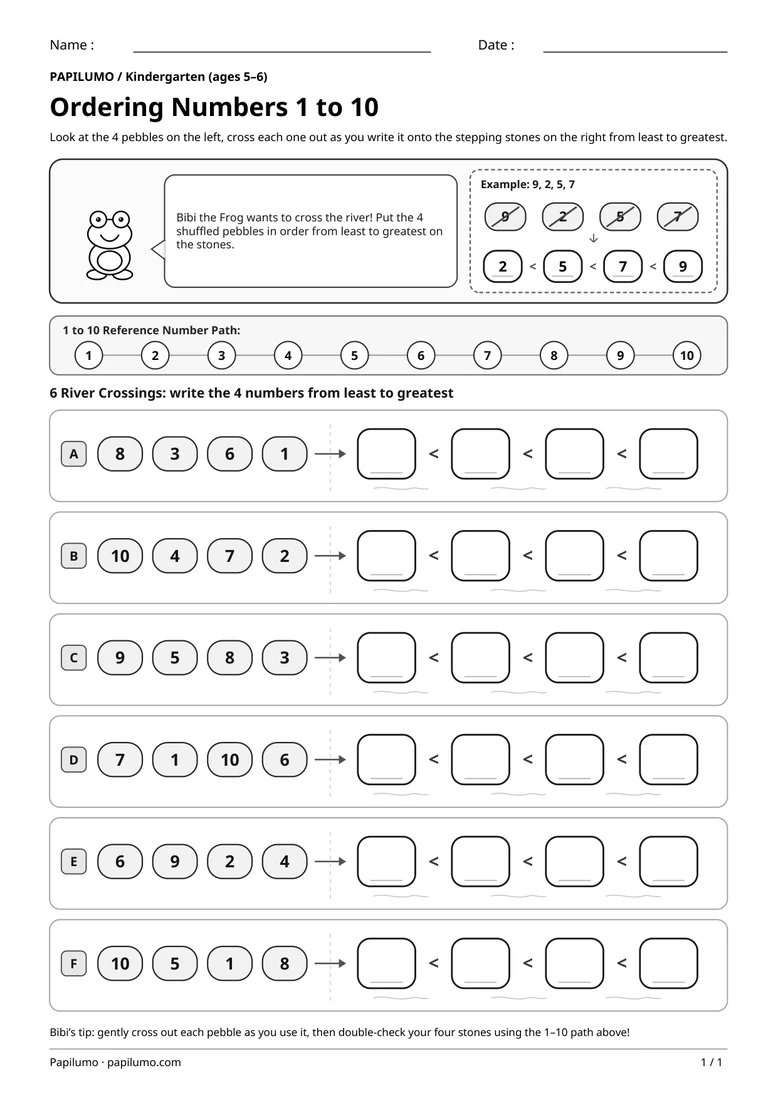
Inside the framed top banner beside smiling Bibi the Frog, a friendly speech bubble sets up the river challenge right next to a clear worked example box using pebbles 9, 2, 5, and 7. Children see each pebble neatly crossed out one by one as it is written in order onto the four river stones: 2, then 5, then 7, and finally 9. Modeling this simple cross-and-write strategy prevents skipped, duplicated, or forgotten digits and gives five-year-olds an immediate, clear blueprint for calm independent success.
Supporting the activity
Below the 1–10 reference path, six horizontal river-crossing rows offer generous writing space inside smooth stepping stones and carefully chosen non-consecutive combinations. On the left bank of each row sit four shuffled number pebbles: 8, 3, 6, 1 in Row A; 10, 4, 7, 2 in Row B; 9, 5, 8, 3 in Row C; 7, 1, 10, 6 in Row D; 6, 9, 2, 4 in Row E; and 10, 5, 1, 8 in Row F. On the right, four spacious stepping stones linked by less-than symbols await the ordered numbers. To vary the practice, try Tens and Ones Word Values & Order Reversals to 99 with Noa: Read carefully whether tens or ones come first before writing each 2-digit number, then match the pairs in Part C.
What to notice and how to check
When all six river crossings are complete, place the separate bold-answer key beside your child’s worksheet to review each path stone by stone. Verify the six ordered sequences together calmly: 1-3-6-8, 2-4-7-10, 3-5-8-9, 1-6-7-10, 2-4-6-9, and 1-5-8-10, checking that every left-hand pebble was crossed out exactly once. If two stones were swapped, point to both numbers on the top 1–10 path together, let your child erase and adjust calmly, and celebrate finishing Bibi’s crossing.
Making the task easier
Place four small counters on the matching numbers along the 1–10 path at the top, then read them left to right to copy them in order.
Keep the learning aim, but reduce how much the child has to handle at once. Cover part of the page with another sheet and reveal one task at a time. Demonstrate a separate example, then leave a real opportunity to work something out. An answer reached with support is still a useful attempt; it does not yet show that the same task can be completed independently.
Taking the idea beyond the worksheet
Pick one extra number between 1 and 10 that is not in the row and ask where Bibi would squeeze it into the stone path.
Use the follow-up to meet the same idea in a different setting. Offer it once the first task makes sense, without insisting that the whole page must be perfect. The child might explain a strategy, make an example or set a challenge for an adult. Return to the worksheet only when it helps connect the two situations. A short conversation or a practical activity can be enough to finish the session. To continue exploring, use Missing Numbers 1 to 10: Garden Trails: Look at Bibi’s snail example, fill in the four counting-up trails (+1), then complete the two counting-back trails (-1).
Downloading and printing the PDF
This free PDF contains one worksheet designed for A4 paper. Download the file using the button on this page and open it in your PDF reader. Choose actual size or a 100% scale, check the orientation in the print preview and turn off any browser headers or footers. The illustrations use vector lines, so their outlines stay sharp when printed. Check the margins on one copy before preparing several sheets for a group. The level shown on the page is a guide, rather than a requirement to complete the activity at a particular age.