

What this worksheet helps children practise
Always read each strip in two quick passes: chant the shapes first, then chant the shading or size.
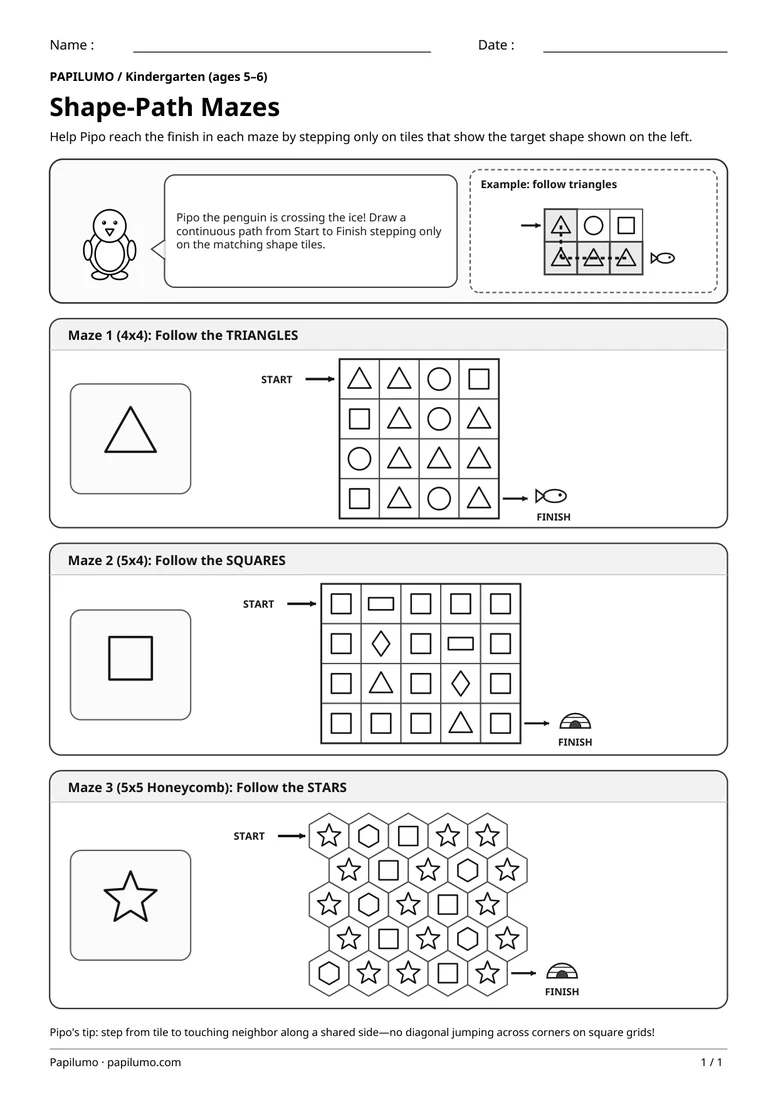
Decoding dual-attribute repeating patterns in Kindergarten builds cognitive flexibility, systematic visual observation, and early algebraic thinking well ahead of first grade. Rather than guessing hastily from a vague visual impression, young learners practice isolating one variable at a time: spotting the shape cycle first (AB, ABC, or AAB), checking the independent shading or size cycle next, and finally combining both answers into one accurate pencil drawing. This strengthens working memory, careful attention to detail, and confident pattern reasoning without distracting color clutter. For a related skill, use Shape-Path Mazes: Follow the Target Shape with Pipo: Help Pipo reach the finish in each maze by stepping only on tiles that show the target shape shown on the left.
Preparing a short session
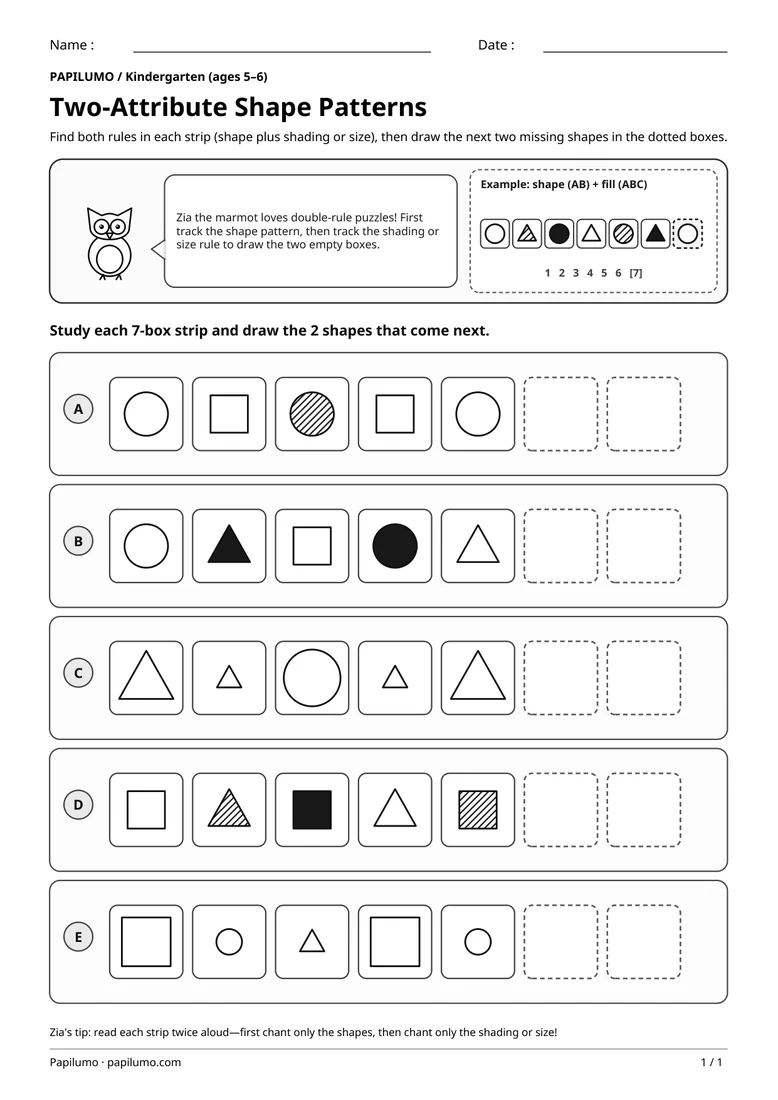
Print the student worksheet at actual size (100%) on plain white A4 paper and sit together at a bright, quiet, uncluttered table with a sharpened pencil and a soft eraser. Keep the separate one-page answer key PDF tucked neatly out of sight until all ten dotted boxes are completely drawn. Before starting Strip A, ask your child to describe aloud the three crisp black-and-white shadings shown in the top example—plain white, diagonal stripes, and solid black—plus the clear size contrast between big and small shapes.
A concrete example to get started
Inside the framed top banner right beside Zia the marmot and the story speech bubble, a worked seven-box mini strip demonstrates both pattern rules clearly at once. The shape rule alternates circle-triangle (AB) while the fill rule repeats white-hatched-black (ABC), making the seventh dotted box a plain white circle. With both rules clearly illustrated side by side in high-contrast black and white, five- and six-year-olds immediately understand how two independent patterns combine cleanly before tackling Strips A through E on their own.
Supporting the activity
Below the banner, five spacious horizontal strips labeled A through E each display five given boxes on the left followed by two empty dotted boxes ready for careful hand drawing. Strip A pairs shape AB (circle, square) with fill AAB (white, white, hatched). Strip B combines shape ABC (circle, triangle, square) with fill AB (white, black). Strip C joins shape AAB (triangle, triangle, circle) with big-small size AB. Strip D crosses shape AB with fill ABC (white, hatched, black), and Strip E blends shape ABC with big-small-small sizing. To vary the practice, try Open vs. Closed Shapes and Straight vs. Curved Sides with Basile: Check Basile's fence key at the top: circle closed shapes and cross out open shapes, tick the side type, then draw one straight line to close each gap.
What to notice and how to check
When all ten dotted boxes are cleanly drawn across the five strips, place the separate one-page answer key PDF beside your child's worksheet to check every single row calmly and cheerfully together. Read the shape rule aloud first and then the shading or size rule for each strip, comparing your child's pencil drawings in boxes 6 and 7 carefully with the solved shapes and the concise rule tag printed clearly under each solved strip. Celebrate how cleanly your young pattern detective combined two separate visual clues at once without ever missing a single detail.
Making the task easier
Point to boxes 1 through 6 saying only circle, triangle, or square out loud, then go back and check white, hatched, or black.
Keep the learning aim, but reduce how much the child has to handle at once. Cover part of the page with another sheet and reveal one task at a time. Demonstrate a separate example, then leave a real opportunity to work something out. An answer reached with support is still a useful attempt; it does not yet show that the same task can be completed independently.
Taking the idea beyond the worksheet
Design your own seven-box double-rule strip on the back of the sheet and challenge a parent to solve boxes 6 and 7.
Use the follow-up to meet the same idea in a different setting. Offer it once the first task makes sense, without insisting that the whole page must be perfect. The child might explain a strategy, make an example or set a challenge for an adult. Return to the worksheet only when it helps connect the two situations. A short conversation or a practical activity can be enough to finish the session. To continue exploring, use Missing shapes in repeating patterns: Look at each pattern. Draw the missing shapes in the empty boxes.
Downloading and printing the PDF
This free PDF contains one worksheet designed for A4 paper. Download the file using the button on this page and open it in your PDF reader. Choose actual size or a 100% scale, check the orientation in the print preview and turn off any browser headers or footers. The illustrations use vector lines, so their outlines stay sharp when printed. Check the margins on one copy before preparing several sheets for a group. The level shown on the page is a guide, rather than a requirement to complete the activity at a particular age.